Get the Latest News
Museum of Arts and Design Presents Porcelain Murals Bridging Nature and the Urban Landscape by Alice Riehl
Alice Riehl’s Porcelain Florilegium
February 28–October 12, 2026
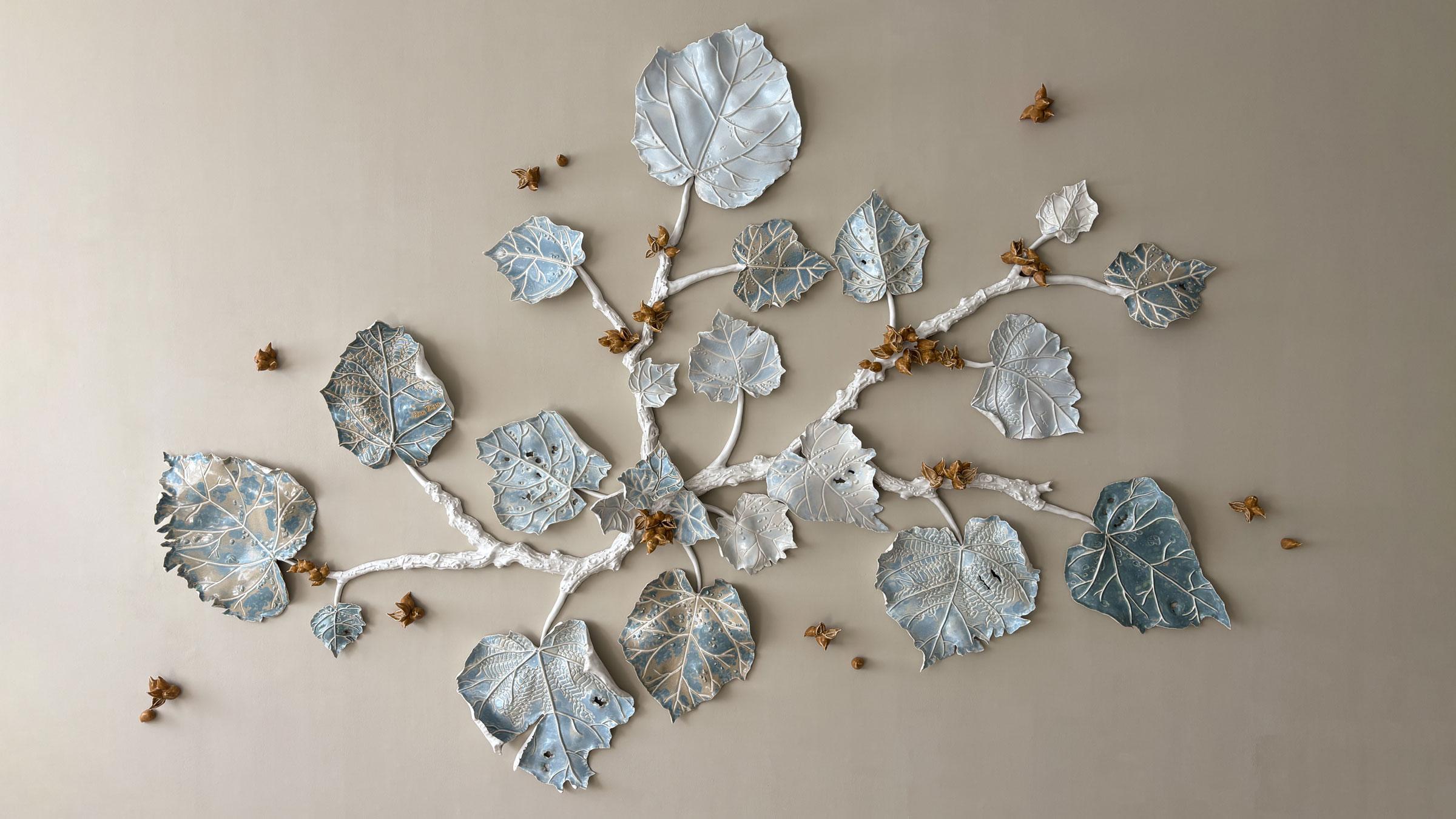
Alice Riehl, Timidité (2025). Photo: Courtesy of Todd Merrill Studio and the artist.
New York, NY (January 21, 2026)
Fragile, luminous, and enduring, porcelain becomes a medium for rethinking plant life in the modern city in Alice Riehl’s Porcelain Florilegium, on view at the Museum of Arts and Design (MAD) from February 28 through October 12, 2026. The installation brings together four monumental wall murals—Timidité (2025), Dent-de-Lion (2024), Songe (2024), and Alter Ego (2022)—marking the first major U.S. museum presentation of Riehl’s work and underscoring MAD’s commitment to contemporary craft and material innovation.
Riehl creates large-scale porcelain wall murals inspired by botanical imagery drawn from medieval and Renaissance tapestries, French decorative arts, mythology, and sustained observation of plant life. Her works treat flora not as ornament but as active subjects, foregrounding root systems, cycles of growth and decline, and the resilience of so-called pioneer plant species that flourish in inhospitable urban environments. The exhibition’s title invokes the term florilegium—historically used to describe a curated collection of botanical images or texts—recast here as a formal gathering of porcelain wall murals shaped by close looking, material process, and botanical study.
Elissa Auther, Deputy Director of Curatorial Affairs and William and Mildred Lasdon Chief Curator at MAD, said: “Alice Riehl expands the legacy of porcelain beyond ornament, positioning it as a medium for ecological reflection and cultural critique. In Porcelain Florilegium, plants emerge as carriers of memory, resilience, and warning, prompting us to reconsider what sustains life in our cities and what we too often overlook.”
In Dent-de-Lion, Riehl directs attention underground, sculpting the roots of common plants to challenge cultural hierarchies that distinguish weeds from valued species. Songe, a lyrical wall mural inspired by the passionflower, weaves together classical mythology, Shakespeare, and feminist art history to address questions of authorship, visibility, and memory. Conceived during the COVID-19 lockdown, Alter Ego draws on the banyan tree to explore duality, vulnerability, and regeneration, offering a meditation on humanity’s conflicted relationship with nature.
The most recent work in the exhibition, Timidité reflects Riehl’s experience of New York City and its pronounced verticality, considering the space cities afford plant life within dense urban environments. The work introduces a distinct scale and composition that underscores the tension between architectural growth and organic presence in the city.
Porcelain Florilegium is accompanied by displays of process materials, including glaze and clay samples, dried flora, tools, sketches, and textiles, as well as video documentation produced during Riehl’s 2025 Villa Albertine residency in New York City. Visitors will be invited to contribute personal reflections on plants meaningful to their lives, extending the exhibition’s inquiry into how art can foster environmental awareness and attentiveness.
Alice Riehl’s Porcelain Florilegium at the Museum of Arts and Design coincides with a concurrent exhibition by the artist at the Musée de la Toile de Jouy in Jouy-en-Josas, France, on view from March 27 through May 24, 2026.
EXHIBITION CREDITS
Alice Riehl’s Porcelain Florilegium is made possible by support from Todd Merrill Studio and a grant from Villa Albertine—as part of Villa Albertine post-residency program, in partnership with Albertine Foundation and supported by Bettencourt Schueller Foundation. Additional funding is provided by the New York State Council on the Arts, with the support of the Office of the Governor and the New York State Legislature, and by public funds from the New York City Department of Cultural Affairs in partnership with the City Council.
ABOUT THE ARTIST
Alice Riehl is a French artist whose monumental porcelain wall murals combine motifs drawn from French decorative arts, organic imagery, and contemporary thought. Her work occupies a liminal space between the natural and the constructed, transforming botanical and marine forms into sculptural compositions that unfold across architectural surfaces. Riehl began her training in porcelain at the French Ceramics Institute in Sèvres in 2003, where she developed a deep engagement with hand modeling as her primary method. Working directly with porcelain, a material prized for its softness, unpredictability, and capacity to reflect light, she embraces the subtle distortions that occur during firing. These shifts introduce complexity and vitality, allowing each work to retain a sense of movement and life while maintaining structural rigor.
In 2010, Riehl expanded her practice into large-scale mural installations, drawing inspiration from the monumental medieval tapestries found throughout Europe. Her porcelain surfaces function as hybrids of textile and sculpture: representational detail gives way to layered textures created by pressing lace and other delicate materials into soft clay. Through asymmetrical compositions and implied motion, Riehl constructs imagined panoramas in which flora, botanicals, and oceanic forms traverse expansive fields, oscillating between abstraction and recognition. Riehl’s work rewards both distance and close looking. While her amplified scale produces an immersive visual experience, intimate details—from subtle glaze variations to meticulously modeled forms—emerge upon closer inspection, fostering a sense of proximity and contemplation.
Riehl lives and works in Paris. Her work has been commissioned for prominent cultural, corporate, and retail settings, including the Chaumet flagship fine jewelry showroom on Place Vendôme in Paris and Château Dauzac in the Bordeaux region of France.
ABOUT THE MUSEUM OF ARTS AND DESIGN
The Museum of Arts and Design (MAD) champions contemporary makers across creative fields and presents the work of artists, designers, and artisans who apply the highest level of ingenuity and skill. Since the Museum’s founding in 1956 by philanthropist and visionary Aileen Osborn Webb, MAD has celebrated all facets of making and the creative processes by which materials are transformed, from traditional techniques to cutting-edge technologies. Today, the Museum’s curatorial program builds upon a rich history of exhibitions that emphasize a cross-disciplinary approach to art and design and reveals the workmanship behind the objects and environments that shape our everyday lives. MAD provides an international platform for practitioners who are influencing the direction of cultural production and driving twenty-first century innovation and fosters a participatory setting for visitors to have direct encounters with skilled making and compelling works of art and design. For more information, visit madmuseum.org.
For high-resolution images, please email press@madmuseum.org.
#AliceRiehlMAD @MADmuseum
Contacts
Museum of Arts and Design
Press Office
+1 212 299 7733
press@madmuseum.org
