Get the Latest News
Museum of Arts and Design Presents First Solo Museum Exhibition for Artist Jessica Lichtenstein
A sweeping solo debut at MAD explores unbridled femininity, ecological imagination, and the radical freedom of the female body, opening May 30, 2026.
Jessica Lichtenstein: Rewilding
May 30, 2026–April 18, 2027
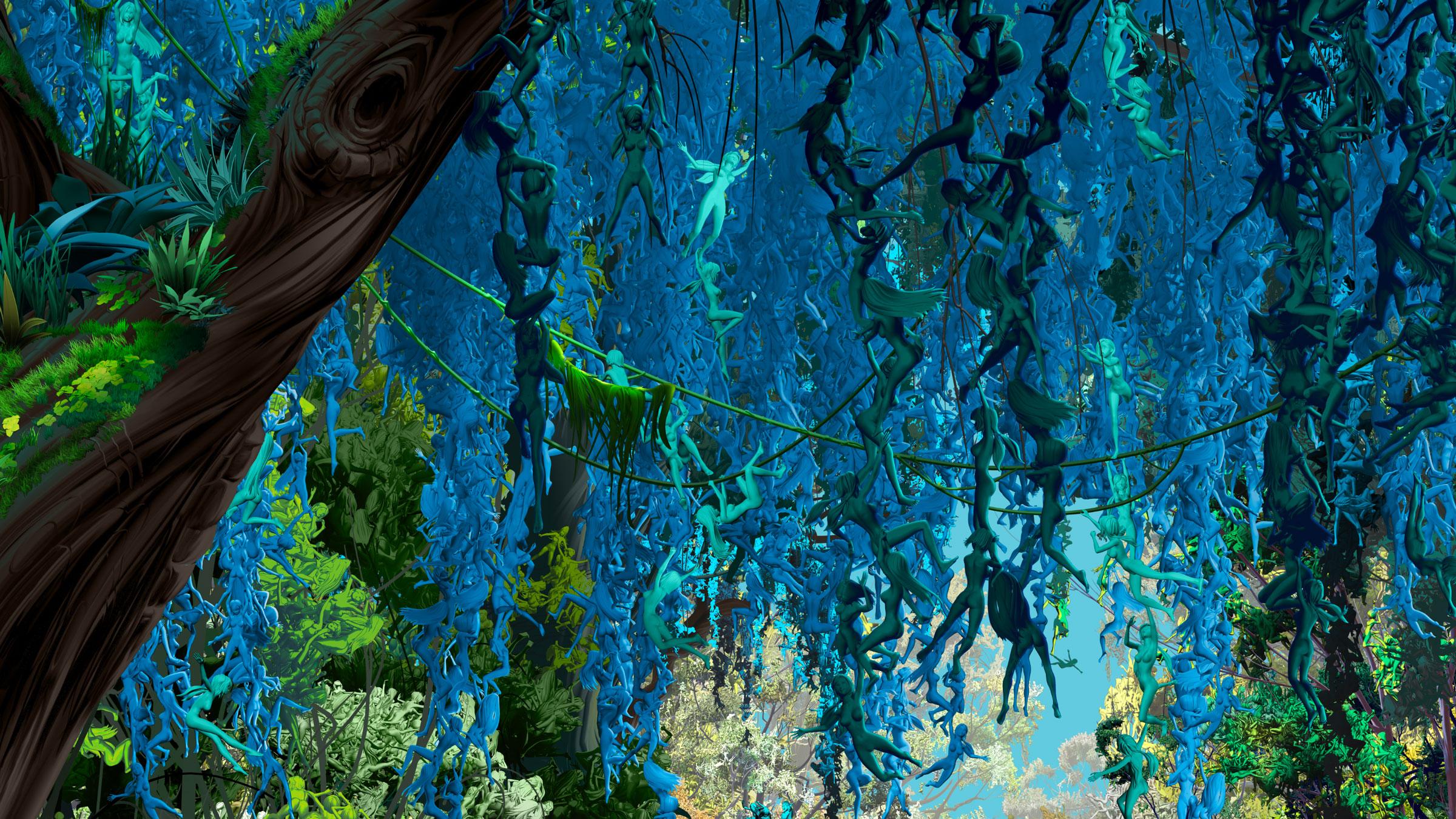
Jessica Lichtenstein, Secret Garden (detail), 2026. Courtesy of the artist
New York, NY (April 23, 2026)
The Museum of Arts and Design (MAD) presents Jessica Lichtenstein: Rewilding, the New York– and Wyoming–based artist’s first solo museum exhibition, on view May 30, 2026, through April 18, 2027. In a sweeping, immersive installation, Lichtenstein transforms the third-floor gallery into a lush, overgrown terrain where thousands of digitally rendered female nudes coalesce into forests, ruins, and flowering canopies. Merging opulent materials with technological precision, Rewilding reclaims the female body from art history’s erotic conventions and situates it within a speculative landscape shaped by autonomy, collectivity, and release.
Rewilding borrows its title from a concept in conservation ecology: the practice of restoring natural processes and wilderness areas by withdrawing human intervention and trusting ecosystems to regenerate on their own terms. For Lichtenstein, rewilding serves as a governing metaphor for liberty and release. Her densely layered, technicolor landscapes, on first viewing lush and uninhabited, reveal upon close inspection thousands of minute digitally rendered female nudes—the artist’s so-called “girls” or “tree nymphs”—who cling, swing, frolic, and soar through a natural world entirely imagined by the artist. Unfettered by patriarchy or even the presence of male figures, Lichtenstein’s female figures embody a radical freedom that she has described as a feminist reimagining of both nature and the female body.
“Jessica Lichtenstein engages one of the most enduring subjects in Western art history and turns it inside out,” said Elissa Auther, MAD’s Deputy Director of Curatorial Affairs and William and Mildred Lasdon Chief Curator. “She adopts the visual language of seduction, ornament, and spectacle, then redirects it toward critique. In Rewilding, the female body no longer serves as a passive motif. It becomes structure, landscape, and force. The result is an environment that is both visually sumptuous and conceptually precise, inviting viewers to reconsider who is looking, who is represented, and who holds power.”
The exhibition is anchored by a quotation from the science fiction writer Ursula K. Le Guin—“What’s a nymph like me to do with something that belongs to men?”—drawn from Le Guin’s 1987 poem The Crown of Laurel. That provocation sets the interpretive frame for the gallery experience, which unfolds across four distinct sections.
The exhibition proceeds from an immersive entry corridor lined with Lichtenstein’s large-scale circular canvases into a sequence of interconnected installations: Secret Garden, After the Fall, Leave Your Thoughts Here, and Shadow Play. Each section extends the artist’s central inquiry into femininity, ecological fantasy, and the history of the female nude in Western art.
Among the exhibition’s signature works is Secret Garden (2026), a site-specific installation in which, like in many of the other artworks on view, Lichtenstein’s nymphs inhabit a hyper-artificial pleasure garden drawn from the 18th- and 19th-century European painting tradition—landscapes that historically framed the female body as a passive erotic object for the male viewer. In Lichtenstein’s reimagining, the viewer enters a space where the female nude is relieved of those erotic obligations entirely.
In After the Fall (2024), through the Gothic windows of an architectural ruin, Lichtenstein presents landscapes overtaken by vegetation, extending the symbolism of ruin and renewal into the present moment.
Occupying the exhibition’s central corridor, Leave Your Thoughts Here (2025) is a 70-foot-long modular sculpture of concrete, plaster, and embedded lockets and watches that functions as a bench for visitors. The lockets are engraved with texts drawn from varied sources including poetry and from social media posts—candid, often rueful observations on beauty standards, romantic frustration, and forbidden desire—forming, in aggregate, a chorus of protest and humor.
The exhibition concludes with Shadow Play (2025), a meditative video animation inspired by Carl Jung’s concept of the shadow self, its whispered soundtrack evoking the repressed thoughts and hidden desires that the rest of the exhibition releases into the open.
During the exhibition’s run, Jessica Lichtenstein: Rewilding will be extended through a series of related public programs and workshops. Additionally, The Store at MAD will stock an exclusive selection of journals and candles embellished with Lichtenstein’s signature tree nymph motif and a fully illustrated companion book to be published later this year by Hirmer Publishers.
EXHIBITION CREDITS
Special thanks to Michael Winn (Vint Augere Studio), and Adam Dryden Illustration.
Support for this exhibition has been generously provided by Michael and Patti Dweck, and by Duggal Visual Solutions.
Jessica Lichtenstein: Rewilding is made possible by the New York State Council on the Arts with the support of the Office of the Governor and the New York State Legislature, and is supported, in part, by public funds from the New York City Department of Cultural Affairs in partnership with the City Council.
ABOUT THE ARTIST
Jessica Lichtenstein is a New York– and Wyoming–based multidisciplinary artist whose practice spans large-scale installation, painting, sculpture, and video. Working at the intersection of feminist theory, ecological thought, and art history, she has developed a singular visual language in which hyperreal, digitally constructed landscapes—densely populated with tiny female nudes she calls her “tree nymphs”—challenge the long history of the eroticized female body in Western art. Lichtenstein’s work draws on a range of sources, from eighteenth-century pleasure garden painting and the Romantic sublime to the science fiction of Ursula K. Le Guin and the Jungian concept of the shadow self. Her mixed-media paintings incorporate gold, brass, and aluminum leaf alongside UV printing and acrylic, producing surfaces of striking material richness. Her sculptural works embed everyday language—women’s social media texts, intimate and unselfconscious—into concrete and plaster forms, recontextualizing vernacular speech as collective feminist testimony. Jessica Lichtenstein: Rewilding at the Museum of Arts and Design is the artist’s first solo museum exhibition.
ABOUT THE MUSEUM OF ARTS AND DESIGN
The Museum of Arts and Design (MAD) champions contemporary makers across creative fields and presents the work of artists, designers, and artisans who apply the highest level of ingenuity and skill. Since the Museum’s founding in 1956 by philanthropist and visionary Aileen Osborn Webb, MAD has celebrated all facets of making and the creative processes by which materials are transformed, from traditional techniques to cutting-edge technologies. Today, the Museum’s curatorial program builds upon a rich history of exhibitions that emphasize a cross-disciplinary approach to art and design and reveals the workmanship behind the objects and environments that shape our everyday lives. MAD provides an international platform for practitioners who are influencing the direction of cultural production and driving twenty-first century innovation and fosters a participatory setting for visitors to have direct encounters with skilled making and compelling works of art and design. For more information, visit madmuseum.org.
For high-resolution images, please email press@madmuseum.org.
#JessicaLichtenstein @MADmuseum
Contacts
Museum of Arts and Design
Press Office
+1 212 299 7733
press@madmuseum.org
